
Technology

Technology as a tool for better rehabilitation
Rehab45 develops and evaluates technologies where they can help us answer important rehabilitation questions. We are engineers, and building things is how we test ideas: robots, sensors, games, models and the software that connects them.
We do not develop technology for its own sake. Our focus is on whether technology can help us understand recovery, improve rehabilitation decisions or make effective rehabilitation more accessible.
What we work across
Each area is listed with the step of our Measure, Model, Decide, Deliver, Learn cycle that it serves, and the projects where you can see it in use.
Rehabilitation robotics
Measure and deliver
Adaptive robotic systems that deliver intensive, personalised assistance for upper and lower limb recovery, and that measure movement while they do it. From home-based devices to research platforms, robots let us change the dose and type of assistance to suit the person.
AI and machine learning
Model and decide
Interpretable models that classify movement, predict recovery and adapt interventions. We use machine learning to turn measurements into decisions that clinicians can understand and act on, rather than as a black box.
Brain-computer interfaces
Measure and deliver
Decoding EEG signals so that movement intention can drive rehabilitation devices, and using neural features to assess impairment and track change over time.
EMG and wearable sensing
Measure
Muscle activity and low-cost inertial sensors that quantify movement quality, effort and real-world upper-limb use outside the laboratory.
Motion analysis and biomechanics
Measure and model
Motion capture and musculoskeletal simulation to characterise how people move and how impairment changes the mechanics of movement, from the laboratory to the living room.
Virtual and interactive rehabilitation
Deliver
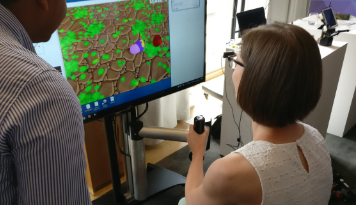
Games and interactive environments that make repetitive practice engaging, provide feedback and let us measure performance at the same time, in the clinic and at home.
Neurostimulation and multi-modal interventions
Deliver
Pairing rehabilitation technologies with electrical and transcranial stimulation to maximise neuroplastic change.
Connected and home rehabilitation
Deliver and learn
Remote-supervised systems, secure data exchange and telerehabilitation that extend safe, effective rehabilitation into the home while keeping clinicians in the loop.
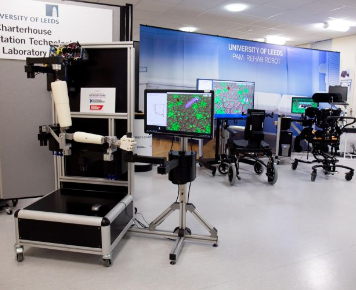
The Charterhouse Rehabilitation Technologies Laboratory at the University of Leeds.
A platform for personalised rehabilitation beyond the traditional clinic
RoboGym explores how rehabilitation technologies, interactive exercises, sensing and intelligent support can work together to provide more opportunities for meaningful rehabilitation.
The long-term aim is to create a flexible rehabilitation environment that can adapt to the individual and connect rehabilitation across clinical, community and home settings.
RoboGym is where the technologies above come together.